
Home remodeling can transform how a house looks, functions, and supports everyday life, but a successful project begins well before construction starts. For homeowners in Lancaster, PA, careful planning helps establish the scope, materials, layout, and budget before work gets underway. Whether the project involves a kitchen, bathroom, addition, sunroom, or larger interior renovation, making these decisions early can help the remodeling process run more smoothly.
CD Beiler Construction handles home remodeling projects in Lancaster, PA. Call (717) 747-4037 to discuss your renovation plans with an experienced team.
Thoughtful planning and quality construction can create a finished home that better fits your needs while adding functionality, comfort, and lasting value.
Home Remodeling Moves at the Speed of Decisions

Many remodeling delays can be traced back to decisions that were not finalized early enough. Tile that has not been selected, a fixture on backorder, or an unresolved layout detail can bring progress to a stop when the crew reaches that stage of the project.
Contractors can only plan as far ahead as project selections allow. When finishes and materials are finalized before demolition begins, trades can be scheduled more efficiently and materials can be ordered with enough time to arrive before they are needed.
Lead times are also easy to underestimate. Cabinetry, windows, specialty tile, and custom millwork often need to be ordered well in advance. A single item selected too late can leave a room nearly complete while the remaining work waits for that material to arrive.
Making selections early, including details such as hardware, fixtures, and paint, gives the project a better chance of staying on schedule. These decisions may feel premature during the design stage, but they can prevent avoidable delays once construction is underway.
Scope and Budget of a Home Remodeling Project
A remodel begins with a clear understanding of what you want to change and why. Wanting more counter space and wanting a completely different floor plan lead to very different projects, and that distinction should be established before estimates are prepared.
Write down the boundary: A clear scope identifies what is included and, just as importantly, what is not. Defining those boundaries early helps prevent misunderstandings, unexpected costs, and changes once construction begins.
Separate needs from preferences: Structural repairs, failing systems, and code-required work may leave little room for adjustment. Finishes and upgrades often offer more flexibility, and knowing the difference gives you areas to reconsider if the project needs to stay within a particular budget.
Hold a contingency: Older homes can hide outdated wiring, previous repairs, water damage, and other conditions behind walls and finishes. Setting aside a reserve for unexpected discoveries helps keep the project moving when something is uncovered during demolition. Your contractor can recommend a reasonable contingency based on the home’s age, condition, and planned scope of work.
Expect a walkthrough where the contractor asks how you currently use the space and what you want to improve. That conversation often identifies practical needs a wish list can miss, and those details are much easier to incorporate during planning than after construction is underway.
Home Remodeling Runs on Sequenced Trades
A remodel follows a fixed order of trades, and each handoff depends on the one before it.
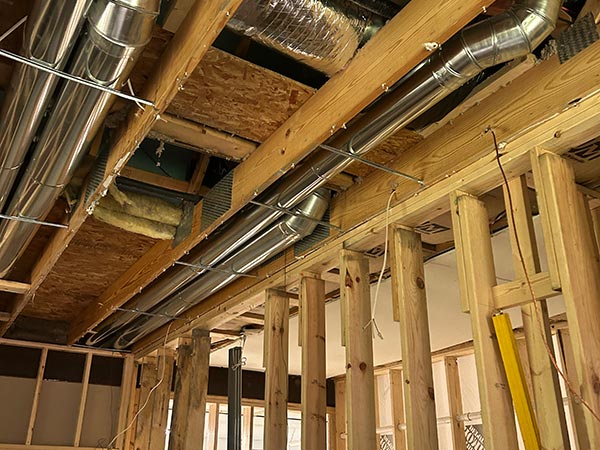
Demolition comes first, followed by any structural framing changes. Rough mechanical work goes in next, meaning electrical, plumbing, and heating and cooling while the walls are still open. Inspections normally happen at that point, and nothing gets covered until they clear.
Insulation and drywall follow, then finish carpentry, cabinetry, tile, paint, flooring, and fixtures in roughly that order. Countertops are usually templated only after the cabinets are set, which is why kitchens have a natural pause built into them.
A single late inspection or missing material pushes everything behind it, so coordination matters more than raw availability. Ask who owns the schedule and how often you will see it updated. Whether trades are in-house or subcontracted matters less than whether one person is accountable for each handoff.
Living Through the Work Takes Planning
Most people stay in the house during a remodel, and those weeks go far more easily when the practical questions get answered in advance.
Decide which rooms stay usable and where dust barriers go. If a kitchen is out of service, set up a temporary space with a refrigerator, a microwave, and a water source before demolition rather than after.
Know when water, power, or heat will be off in the work area and roughly for how long. Agree on working hours, daily cleanup, where materials are staged, and how the crew comes and goes.
A change order is the written agreement that updates price and schedule when the work changes, and every mid-project change should get one. A change made on paper always costs less than the same change made after it has been built.
Lancaster Home Remodeling Specialists
A successful home remodeling project depends on more than quality construction. Careful scheduling, reliable supplier relationships, and clear communication all help keep the work moving from one stage to the next. Before choosing a contractor, homeowners should understand how selections are managed, how changes are handled, and who will serve as their primary point of contact throughout the project.
CD Beiler Construction handles home remodeling in Lancaster, PA. Call (717) 747-4037 today to discuss your renovation plans with an experienced local team.
Choosing a contractor based on planning, communication, and workmanship rather than price alone can lead to a smoother remodeling experience and a finished home built for lasting value.
FAQ
What should I have ready before meeting a remodeling contractor?
A budget range, a list separating what must change from what would be nice, and photos of work you like. Those three lead to a far more accurate proposal.
Does a home remodel require a permit in Pennsylvania?
It depends on the work and the municipality. Structural changes, additions, and new electrical or plumbing typically require one, while cosmetic updates often do not.
What is a punch list and when does it happen?
It is the final list of small corrections compiled during a walkthrough near the end of the project. The job is not complete until every item is closed out.