
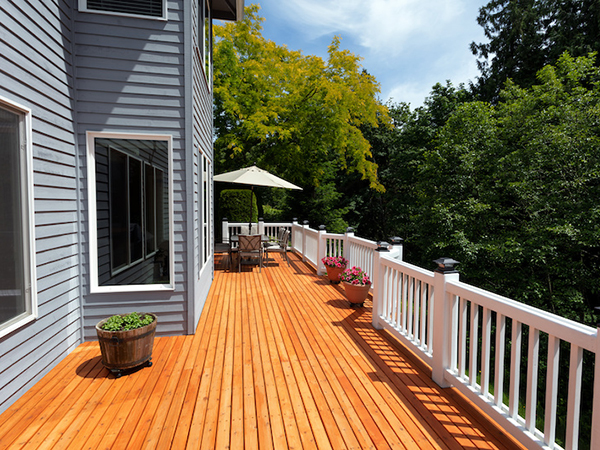
Most deck conversations start with size and decking material. The questions that decide whether the finished deck is safe and usable start somewhere else. A good deck contractor in Lancaster walks the site first. At CD Beiler Construction, that walk covers each detail including the stairs that will be integrated, any needed ground preparation and the anticipated use of the deck. This detailed planning reduces the risk of issues occurring later in the construction process.
Call CD Beiler Construction at (717) 747-4037 for deck contractor services in Lancaster, PA.
Plan the Stairs First with Your Deck Contractor
Stairs are the part most homeowners think about last, after the layout is settled and the stair run has nowhere good to go.
Rise and run have to stay consistent across every step. A single step that differs from the others by even a small amount is the one people trip on. Feet learn the rhythm of a staircase within two steps and stop looking. That consistency requires knowing the finished grade before the deck height is locked in, which is why stair planning belongs at the start rather than the end.
Landing space matters just as much. A stair that dumps onto sloped ground, or into a mulch bed that shifts, creates a hazard no railing fixes. Where the stairs land and whether that surface stays level through a wet Pennsylvania spring belong in the design.
The Difference Between Railings and Guards

Homeowners use one word for two different things. A guard keeps someone from falling off the edge of the deck. A handrail gives a hand something to hold going up or down stairs. Most decks need both, and they are not interchangeable.
Guard height and baluster spacing are the two details inspectors look at first, because both exist to keep small children from getting through or over. Handrails have their own requirements around graspability, which is a plain way of saying a hand has to be able to close around it. A wide flat board mounted on top of a guard looks tidy and does not work as a handrail.
Attachment is often the unspoken failure point. A post that looks solid can still be attached in a way that will not hold a lateral load. Posts that pass through the framing and bolt to structure behave very differently under pressure than posts fastened to the outside face of a rim board. That detail becomes invisible the moment the decking goes down.
What a Deck Contractor Checks on the House
A deck attached to a house is only as sound as the thing it is attached to.
The ledger board is the single most important connection in the structure. It carries a large share of the deck load into the house framing. That means solid framing, the right hardware, and flashing so water cannot get behind it. Ledger flashing failures are slow. Water works into the rim joist for years before anything shows up inside.
Existing conditions get inspected before anything is designed. Older Lancaster County homes come with a mix of framing types, siding materials, and previous alterations, and what sits behind the siding is not always what the exterior suggests. Where a house cannot take a ledger safely, a freestanding deck with its own posts on that side is the honest answer.
Doors and thresholds drive the design too. Deck height relative to the door sill affects water management and whether stepping outside feels natural or feels like a drop.
Access, Grade, and How People Use a Deck
Frost depth governs footings in Pennsylvania, so footing depth is not a place to save time. Beyond that, site drainage decides how long the structure lasts. Water pooling around posts, or sheeting toward the house because the deck changed how the yard drains, causes problems that surface years later.
Accessibility deserves an early conversation. If anyone in the household struggles with stairs, say so early. A lower deck with a gentler transition, or a graded path to grade level, is far easier to build once than to retrofit later. Wider stairs, deeper treads, and a landing partway down make a deck usable by more people without looking institutional.
Permitting follows the design. A contractor working in the area regularly knows which municipality reviews what, and a complete drawing set with framing details, footing sizes, and railing specs keeps a project from stalling at inspection.
Working With a Lancaster Deck Contractor
A deck is a structure people stand on and carry things down. The planning that makes it safe happens before any lumber arrives, in decisions about stairs, guards, attachment, and grade that are difficult to change later. A contractor who raises those questions unprompted is the clearest signal you are in good hands.
For deck contractor services in Lancaster, PA, contact CD Beiler Construction at (717) 747-4037 today.
FAQ
Do I need a permit to replace an existing deck in Lancaster County?
Requirements vary by municipality, and replacing structural components often triggers a permit even when the footprint stays the same. Your contractor should confirm with the local code office before work starts.
How long does a deck inspection take after construction?
Most residential deck inspections are short visits, though scheduling depends on the municipality’s workload, so building that wait into the timeline avoids surprises.
Should a deck be built before or after landscaping?
Build the deck first. Final grading, plantings, and walkways are much easier to fit around a finished structure than to protect during construction.