
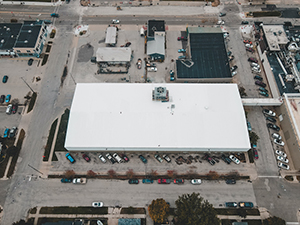
Commercial metal roof repair quotes often come back higher than expected, and the reason is rarely the visible damage. The real issue is usually found in the fasteners. Exposed-fastener metal roofs are built with thousands of screws, each sealed by a rubber gasket that can wear down over time and compromise the system.
CD Beiler Construction repairs commercial metal roofing systems for properties in Bethel Park, PA. Call 717-747-4037 to evaluate the condition of your fasteners and understand what your roof actually needs.
Seasonal temperature swings create constant expansion and contraction across the roof surface. Over time, that movement stresses each fastener and gasket, leading to loosening, deterioration, and potential leaks if not addressed early.
Commercial Metal Roof Repair Scope
A commercial metal roof panel 50 feet long expands and contracts by roughly three-quarters of an inch across Pennsylvania’s full temperature range. That movement is not visible, but it matters to every fastener. As the panel moves and the fastener does not, the hole around it elongates incrementally. The gasket under the screw head compresses on warm days and decompresses on cold ones, losing its seal over years of cycling.
A gasket that has been cycling for ten Pennsylvania winters develops micro-tears that make it leak under heavy rain or snow load. The building owner notices a leak, a contractor seals that fastener, and the same process repeats at the next compromised fastener. A properly scoped commercial metal roof repair addresses fastener conditions across the affected zone, not one screw at a time.
Why Metal Roof Repair Quotes Vary

Three contractors assessing the same commercial metal roof leak in Pennsylvania will often produce three dramatically different quotes. The lowest reseals the specific fastener and calls it done. The highest includes a full fastener condition assessment across the affected panel runs and proposes gasket replacement where elongated holes have compromised attachment.
None of those scopes is automatically wrong. The question is whether the diagnosis matches the actual condition. A ten-year-old commercial metal roof in southwestern Pennsylvania that has been through ten full thermal cycles without a fastener inspection almost certainly has compromised gaskets beyond the single visible leak location. A quote that only addresses what is dripping is a quote for the symptom. A quote that includes a fastener survey and addresses the zone of degradation is a quote for the problem. The difference in scope explains most of the price variation building owners see.
The Commercial Metal Roof Repair That Looks Fixed But Leaks Next Winter
Surface sealing over a metal panel that has lost its galvanized or painted protective coating is one of the most common commercial metal roof repair approaches that passes a summer inspection and fails by February. The sealant bridges the visible gap or corrosion spot, the roof holds through warm weather, and the building owner considers it resolved. Pennsylvania’s first hard freeze then puts thermal stress on the sealed area, the sealant debonds from the corroded panel substrate, and water finds the same path it used before.
The root cause is substrate condition, not the gap. Corroded metal does not hold sealant adhesion through thermal cycling. A repair that skips substrate preparation is building the next repair into the current one. In Pennsylvania’s climate, where freeze-thaw tests every adhesion point twice a season, that is not a detail that can be skipped.
How Snow Load Changes Commercial Metal Roof Repair Scope
Southwestern Pennsylvania receives heavy wet snowfall. Panel deflection under that load puts tension on fastener holes already elongated from thermal cycling, and snow weight pressing against a raised seam edge creates a hydraulic effect that drives water through gaps that are dry-weather tight.
A commercial metal roof repair scoped in fall needs to anticipate snow load, not just rain. Seam repairs adequate for summer rain may not hold under a heavy Pennsylvania snowpack. A contractor who ignores snow load in the fall repair scope is delivering a warmer-season solution for a year-round roof.
Quality Commercial Metal Roof Repair
The difference between a commercial metal roof repair that lasts through multiple Pennsylvania winters and one that fails within a season comes down to the depth of the diagnosis. A proper evaluation looks beyond surface issues to assess fasteners, panels, and underlying components to ensure the repair is built to handle full seasonal conditions.
CD Beiler Construction repairs commercial metal roofing systems for properties in Bethel Park, PA. Call 717-747-4037 to schedule an evaluation and determine exactly what your roof needs.
A detailed assessment helps ensure repairs are designed for long-term performance, reducing the likelihood of callbacks and keeping the roofing system reliable through changing weather cycles.
FAQ
How often do commercial metal roof fasteners need to be replaced in Pennsylvania?
On an exposed-fastener system, gasket condition should be inspected every 7 to 10 years in Pennsylvania’s climate, with replacement in zones showing elongated holes or compression-set gaskets.
Why does my commercial metal roof only leak when it snows and not when it rains?
Snow load creates downward and lateral pressure on seams and fastener holes that rain does not. Gaps that are rain-tight can allow water intrusion under the hydraulic pressure of wet Pennsylvania snowpack.
Can a corroded commercial metal roof panel be repaired or does it need replacement?
Panels with surface corrosion can sometimes be cleaned, primed, and sealed. Panels with through-corrosion or structural compromise need replacement, as sealant over degraded metal will not hold through thermal cycling.
Is there a best time of year for commercial metal roof repair in PA?
Fall is ideal, before freeze-thaw cycling begins and while temperatures still support sealant adhesion. Spring is the next best window after inspecting for winter damage.